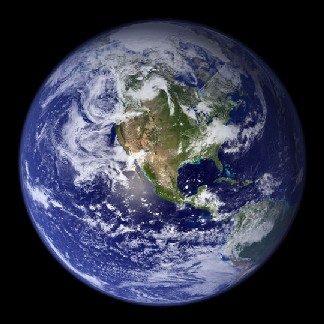
Earth is the only planet in the Solar System with plate tectonics. The outer crust of the Earth is broken up into regions known as tectonic plates. These are floating on top of the magma interior of the Earth and can move against one another. When two plates collide, one plate can go underneath another.
This process is very important. When microscopic plants in the ocean die, they fall to the bottom of the ocean. Over long periods of time, the remnants of this life, rich in carbon, are carried back into the interior of the Earth and recycled. This pulls carbon out of the atmosphere, which makes sure we don’t get a runaway greenhouse effect, like what happened on Venus.
Without the plate tectonics, there’d be no way to recycle this carbon, and the Earth would overheat.
Earth is almost a sphere
The Earth’s shape could be described as an oblate spheroid. It’s kind of like a sphere, but the Earth’s rotation causes the equator to bulge out . What this means is that the measurement from pole to pole is about 43 km less than the diameter of Earth across the equator.
Even though the tallest mountain on Earth is Mount Everest, the feature that’s furthest from the center of the Earth is actually Mount Chimborazo in Ecuador.
Earth is mostly iron, oxygen and silicon
If you could separate the Earth out into piles of material, you’d get 32.1 % iron, 30.1% oxygen, 15.1% silicon, and 13.9% magnesium. Of course, most of this iron is actually down at the core of the Earth. If you could actually get down and sample the core, it would be 88% iron. 47% of the Earth’s crust consists of oxygen.
70% of the Earth’s surface is covered in water
When astronauts first went into the space, they looked back at the Earth with human eyes for the first time, and called our home the Blue Planet. And it’s no surprise. 70% of our planet is covered with oceans. The remaining 30% is the solid ground, rising above sea level.
The Earth’s atmosphere extends out to 10,000 km
The atmosphere is thickest within the first 50 km or so, but it actually reaches out to about 10,000 km above the surface of the planet. This outermost layer of the atmosphere is called the exosphere, and starts about 500 km above the surface of the Earth. As we said, it goes all the way up to 10,000 km above the surface. At this point, free-moving particles can actually escape the pull of Earth’s gravity, and be blown away by the Sun’s solar wind.
But this high atmosphere is extremely thin. The bulk of the Earth’s atmosphere is down near the Earth itself. In fact, 75% of the Earth’s atmosphere is contained within the first 11 km above the planet’s surface.
The Earth’s molten iron core creates a magnetic field
The Earth is like a great big magnet, with poles at the top and bottom of the planet, near to the actual geographic poles. This magnetic field extends from the surface of the Earth out thousands of kilometers – a region called the magnetosphere.
Be grateful for the magnetosphere. Without it particles from the Sun’s solar wind would hit the Earth directly, exposing the surface of the planet to significant amounts of radiation. Instead, the magnetosphere channels the solar wind around the Earth, protecting us from harm.
Scientists think that the magnetic field is generated by the molten outer core of the Earth, where heat creates convection motions of conducting materials. This generates electric currents that create the magnetic field.
Earth doesn’t take 24 hours to rotate on its axis
It’s actually 23 hours, 56 minutes and 4 seconds. This is the amount of time it takes for the Earth to completely rotate around its axis; astronomers call this a sidereal day. Now wait a second, that means a day is 4 minutes shorter than we think it is. You’d think that time would add up, day by day, and within a few months, day would be night, and night would be day.
Remember that the Earth orbits around the Sun. Every day, the Sun moves compared to the background stars by about 1° – about the size of the Moon in the sky. And so, if you add up that little motion from the Sun that we see because the Earth is orbiting around it, as well as the rotation on its axis, you get a total of 24 hours. Now that sounds like the day we know.
A year on Earth isn’t 365 days
It’s actually 365.2564 days. It’s this extra .2564 days that creates the need for leap years. That’s why we tack on an extra day in February every year divisible by 4 – 2004, 2008, etc – unless it’s divisible by 100 (1900, 2100, etc)… unless it’s divisible by 400 (1600, 2000, etc).
Earth has 1 moon and 2 co-orbital satellites
As you’re probably aware, Earth has 1 moon (The Moon). But did you know there are 2 additional asteroids locked into a co-orbital orbits with Earth? They’re called 3753 Cruithne and 2002 AA29. We won’t go into too much detail about the Moon, I’m sure you’ve heard all about it.
3753 Cruithne is 5 km across, and sometimes called Earth’s second moon. It doesn’t actually orbit the Earth, but has a synchronized orbit with our home planet. It has an orbit that makes it look like it’s following the Earth in orbit, but it’s actually following its own, distinct path around the Sun.
2002 AA29 is only 60 meters across, and makes a horseshoe orbit around the Earth that brings it close to the planet every 95 years. In about 600 years, it will appear to circle Earth in a quasi-satellite orbit. Scientists have suggested that it might make a good target for a space exploration mission.
Earth is the only planet known to have life
We’ve discovered past evidence of water on Mars, and the building blocks of life on Saturn’s moon Titan. We can see amino acids in nebulae in deep space. But Earth is the only place life has actually been discovered.
But if there’s life on other planets, scientists are building the experiments that will help find it. A new rover called the Mars Science Laboratory will be heading to Mars in the next few years, equipped with experiments that can detect life in the soil on the Red Planet. Giant radio dishes scan distant stars, listening for the characteristic signals of intelligent life reaching out across interstellar space. And new space telescopes, such as the European Space Agency’s Darwin mission might be powerful enough to sense the presence of life on other worlds.
But for now, Earth is the only place we know where there’s life. Now that is an interesting fact.
I hope you enjoyed these 10 interesting facts about planet Earth.